Mary Lamb and the Botham family
Other PeopleMary Lamb’s relationship with the Botham family is a brief, consequential experience of being welcomed without being fully understood. The family offers her routine and shelter when she is disoriented, and for a time their cramped home feels like enough. Yet the household’s care is inseparable from its strains: alcoholism shapes family life, each member interprets Mary differently, and an attack leaves the family scattered and unable to keep her. The bond is real, but it cannot become a permanent refuge.
An uncertain welcome
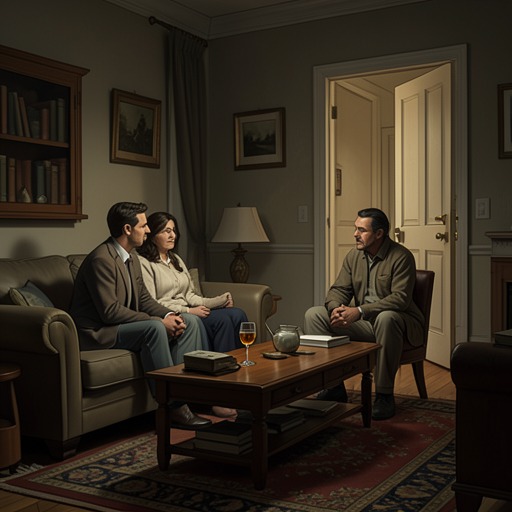
Mary’s entry into the household begins amid confusion. When Sharon’s parents arrive, Mary does not understand the reunion or her place in it; she watches with provisional panic, aware that the streets have taught her to expect traps. The scene soon changes register. In the lounge, Mr and Mrs Botham bicker companionably with their daughter and repeatedly appeal to Mary for support. They call her Mary and include her in their family talk rather than demand an explanation for her presence. That welcome reassures her, even as she wonders what they want from her and why they treat her as someone who can corroborate their complaints.
The family’s ease with one another does not make Mary feel that she has understood them. She sees their kinship asserted through the repeated language of parents and children, but remains unsure what family attachment means. Gavin Botham stands apart from the household’s air of lost time. Mary is struck by his watchful eyes and senses in him a knowledge beyond what she has encountered so far. This early impression helps explain why his later practical care matters to her, even when he speaks brusquely.
Care in an alcoholic household
Alcoholism is not a private problem confined to one member of the family. Sharon is an alcoholic, and Mrs Botham describes her own past drinking as involving substances beyond ordinary alcohol. She insists that alcoholism persists even after sobriety, while Mr Botham calls himself an ex-alcoholic and Gavin bluntly identifies his mother as an alcoholic. The disagreement makes recovery a contested family vocabulary: Mrs Botham treats sobriety as a moral and personal achievement, while the others puncture or qualify her account. The narrative’s broader generalizations about drinkers are a framing voice, not a clinical assessment of the family; within the household, addiction is understood through argument, memory, and repeated behavior.
Mrs Botham’s efforts to help are part of the welcome she extends to Mary. She recalls a woman from a clinic who could remember little after a blow to the head, and uses the story to make sense of Mary’s condition. She also speaks warmly of Al-Anon and its pamphlets, whose accounts of drinking, secrecy, and recovery mirror the language she uses herself. Her concern is sincere, though Mary is not always an attentive listener. By this point she has learned to remain companionably present while Mrs Botham talks, because Mrs Botham values the act of talking as much as any answer.
The household’s evening habits give Mary a temporary structure. At nine, Mrs Botham goes into the kitchen while the television is on; at half past nine she returns with toast, tea, and biscuits. Gavin says she drinks again while alone in the kitchen, and Mary believes him. Even so, she is grateful for what Mrs Botham has done to make her welcome. The routine’s modest comforts become especially important when Mary later recognizes how much she has come to depend on the room and the people in it.
A family with different explanations of Mary
The Bothams do not share one account of who Mary is. Mrs Botham alone is convinced that Mary has amnesia, and keeps advancing that explanation. Gavin Botham instead regards Mary as having the mind of a bright, curious, systematic twelve-year-old, someone who may become very clever as she grows up. Mr Botham privately suspects that she is normal in every respect. Their disagreement gives Mary a place in the household without resolving her identity: they accept her presence, but interpret it through their own expectations.
Gavin’s response combines distance with practical generosity. He spends time with his magazines and books, and allows Mary to use his books when she begins reading in earnest. His own sense of being poorly educated, despite eleven years at school, opens a route for her into language and learning. He does not become demonstrative, but his willingness to share what he has and to help her later marks a form of attachment expressed through actions rather than reassurance.
The welcome broken and the departure
For a short time, Mary experiences the family’s company as a sufficient home. She likes sitting beside Gavin, likes Mr and Mrs Botham where they are, and finds comfort in the room’s familiar objects and evening food. At the sound of a visitor at the door, however, she has an immediate sense that change has arrived and that she has already lost the room. The family’s refuge is exposed as vulnerable when Jock and Trev enter the house. Gavin intervenes to protect his parents and Mary; the confrontation leaves Mr Botham seriously injured, and Mary does not move during it.
The next day Mary is alone again. Gavin has made a statement and does not want to discuss it. On the Underground journey back, he offers laconic warnings, while neither he nor Mary says much. The journey makes the consequences plain to Mary: Mr Botham, who worked as a carpet-layer when he could find employment, may not be able to work while his back recovers. Mrs Botham is at the hospital day and night and is drinking more heavily, or at least more openly. The family’s circumstances have changed, and Mary recognizes that there is no longer a place for her in the house.
Mary asks whether she and Gavin can stay there and hope that his parents return. Gavin rejects the idea on financial grounds: the household has no leeway to support her. His refusal does not erase his concern. He says he will dislike thinking of her in the hostel, helps pack a suitcase with Sharon’s and Mrs Botham’s clothes, explains how to travel there, and gives her four pounds, all he can spare. He embraces her tightly at the door. Mary senses that he is already emotionally withdrawing into the separation, and breaks away to leave.
The relationship’s limits and significance
The Botham family gives Mary more than temporary shelter: it offers recognition, ordinary routines, books, food, and a place in a lively, imperfect household. Its care is neither idealized nor consistently perceptive. The family’s competing explanations of Mary reveal their uncertainty, while their own arguments over alcoholism show that care can coexist with denial, relapse, and bluntness. Their welcome nevertheless allows Mary, for a time, to feel that she is all right and that the present might continue.
That possibility ends not because affection was absent, but because violence and poverty narrow what the family can do. Mr Botham’s injury removes his capacity to work, Mrs Botham’s attention shifts to the hospital, and Gavin cannot afford to keep Mary there. His farewell is therefore both an act of care and an admission of its limits. The relationship stands as one of Mary’s brief experiences of belonging: substantial enough to matter, but too precarious to protect her from the next displacement.